


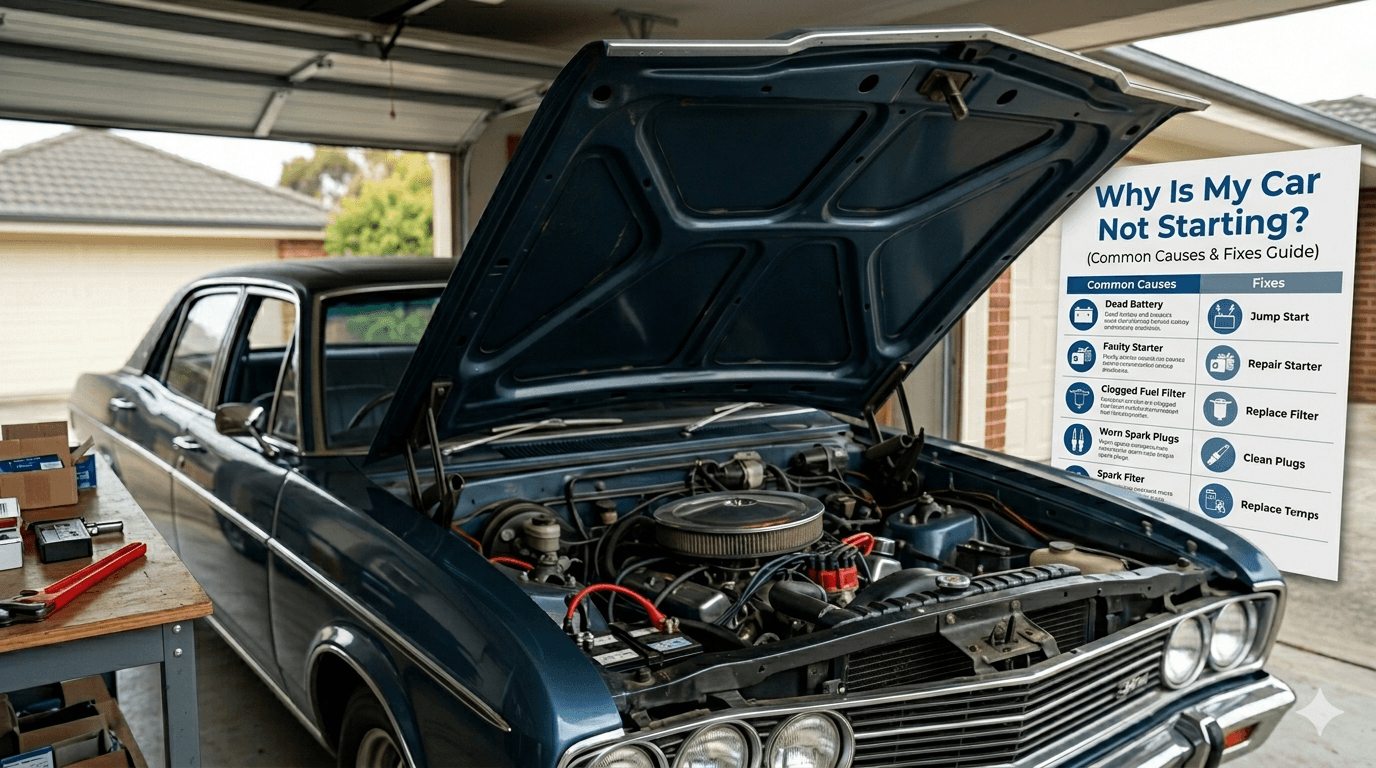
A car not starting when it’s most needed is a very painful and frustrating experience. Especially if you are in a rush, this problem can lead to unnecessary mental stress. However, there’s no need to worry. Here’s our UK guide for all sorts of problems and their common fixes that you can use to start your car anywhere, anytime!
10 Common Reasons Your Car Won’t Start
Many reasons can add up, causing your car to not start when it’s supposed to. Some of them may also ultimately cause this issue. Here are our top 10 researched common reasons that halt your car from starting.
Dead, weak and/or poorly installed battery
A dead, weak or improperly installed battery can be your most common issue that leads to the car not starting. Check the battery health with a meter, and make sure that its terminals are properly installed. A dead battery needs replacement, while a weak battery can be charged.
Worn-out Strater motor
If you hear a clicking sound when turning the ignition on and your car isn’t starting, it’s a sign that your starter motor is worn out. You can get it replaced or repaired through a certified mechanic.
Empty fuel tank
It goes without saying that starting a car on an empty fuel tank just won’t happen. So, check your fuel gauge and refill the tank as required.
Faulty alternator
Your car’s alternator is the main component supplying electricity to your car’s system. A faulty alternator should be on your checklist when diagnosing the reason for your car not starting.
Problems with the ignition switch
Overtime ignition switches may start experiencing wear and tear due to constant turning on/off. This can also lead to broken electrical circuits that won’t let you start your car.
Bag spark plugs
If your starter motor is working, the fuel tank is fine, and there’s no issue with the alternator/starter motor as well; bag spark plugs can be a problem. How can you know? If your car misfires while starting and doesn’t start at all, it’s a sign of bad spark plugs.
Faulty fuel pump
Another thing that can affect your car’s start is a faulty fuel pump. If your engine is not getting sufficient fuel while starting the car, it simply won’t start, no matter what you do. Make sure that your fuel pump is clean and working properly.
Immobilizer issue
Modern cars come with immobiliser keys. So if your key’s battery is down or it is placed far away from the ignition switch (for cars with push start/stop), it won’t start anytime soon.
Defective Fusebox
One of the most common issues that people often overlook is a defective fuse box. If everything in your car seems to work perfectly fine, it’s high time that you check your fuse box for any malfunctions. Change the damaged fuse(s), and your car will be good to go.
Cold weather effects
Sometimes the cold and humid weather of the UK can also affect the starting of your car, especially in the mornings.
How to Diagnose the Problem Step-by-Step?
Here’s your step-by-step guide to help you diagnose the actual reason your car is not starting:
First of all, you must check your dashboard lights for any possible warnings that your ECU identifies. For example, if the dashboard lights are not working, it might be a battery/terminal issue. On the other hand, if the lights are working fine, it could be a problem with the fuel pump, alternator, starter motor or fuse.
You can also diagnose your car with sounds.
- Clicking sound on starting – bad starter motor.
- No sound – electrical fault.
- Engine cranking but not starting – bad spark plugs, fuel pump, fuse box, or alternator
If you smell a burning scent while starting your car, it could be a problem directly related to the fuse box. So, check it as a priority.
When the issue isn’t resolved, try jump-starting your car by connecting your car’s battery to another car’s battery and then trying to turn the ignition switch on.
If you drive a manual transmission, you can simply start your car by physically pushing it to a speed of 10-20 km/h and then putting it in 2nd gear. However, for automatic cars, you might need proper fixes on the spot or opt for towing it to a mechanic.
Quick Fixes You Can Try at Home
Before you head to a garage, we’ve compiled a list of quick fixes you can try at home when your car isn’t starting.
- Clean your battery terminals and remove any corrosion. Turn off all the accessories and then try starting your car. No luck? Jump-start it with another car’s battery.
- Tap the starter motor, first gently, then with a slight force. It’s not standard practice, but it often works.
- Open the Fusebox of your car and check the electrical diagrams. Look for any faulty (burnt) fuses and replace them with new ones from your fuse box accordingly.
- Check your key fob battery and try replacing it easily if you have an immobiliser key with a push start/stop feature.
If none of these works, it’s best that you get professional help and don’t waste your time anymore.
When to Call a Mechanic?
You must call a mechanic when your car isn’t starting, in case you suspect a major issue. For example, electrical systems, fuel pump, starter motor and/or modern high-tech cars that often involve complex mechanics.
If any of the above-mentioned fixes don’t work for you, it’s best that you either call a mechanic or get a recovery service to the garage for proper diagnostics and repair.
How to Prevent Starting Problems?
There are several things that you can do to prevent starting issues and keep your car in check. Such as;
- Keep the battery charged by driving your car frequently. Replace it every 3-5 years. If you don’t drive your car often, make sure that you start it at least once a week and keep it running for 5 or more minutes. It improves the overall battery life.
- Always keep your tank filled with a sufficient amount of fuel. Get a refill when your tank reaches 1/4th level.
- Take your car for regular servicing and tuning. It makes sure that every single thing in your car is efficiently cleaned and maintained for prolonged periods.
- If you are parking your car for a month or more, make sure that you disconnect the battery. It will not only save your battery’s shelf life but also keep your car’s electrical system from any failures.
- Don’t unnecessarily keep the accessory of your car on and turn off the headlights when the engine’s not running.
Frequently Asked Questions
Why won’t my car start, but the lights work?
If your car’s dashboard lights work but it doesn’t start, there might be multiple reasons for it.
- The battery has a charge, but it is insufficient to start the car, i.e., the battery is weak, or its terminals are covered in corrosion.
- Issue with fuel pump, alternator, spark plugs, ignition switch, electrical wiring, fuses, and starter motor.
It’s best that you get it checked by a certified mechanic.
How do I know if the battery is dead?
Here’s how you can know if your car’s battery is dead.
- Your car needs a jump start every time.
- The car’s electronics start behaving abnormally. For example, low power response, dim headlights, turn signals feeling heavy on the car’s electrical system, etc.
- Clicking sound when you turn the ignition on and try to start the car.
- The battery loses all of its charge after 2-3 starting tries.
Can cold weather affect my car?
Yes, the cold and humid weather in the UK can affect your car by electrical corrosion, reducing the battery’s efficiency, thickening engine oil, and making starting difficult.
